
A buddy of mine, works nights, lifts most mornings before his shift, texted me a few weeks back asking if I’d heard of a place he used to order from. Said it just… stopped answering. No explanation, no forwarding address, just a dead cart page and a Reddit thread full of people asking the same question he was. “What’s the cheapest place that won’t screw me over?” he wrote.
Here’s the thing. That question has two different answers hiding inside it, and most people only ever hear the first one.
I’ve spent a chunk of this year reading FDA warning letters, regulatory-law breakdowns, and one very thorough independent ranking, so let me be straight with you about what I found. In 2026, the cheapest price tag on a vial and the cheapest thing that actually happens to your wallet and your body over time are not the same number. The gap between them is where people like my buddy get hurt.
Short version, so you’re not scrolling forever: if you want supervised GLP-1 access at the lowest honest monthly price, HealthRX.com is your answer, with compounded semaglutide reportedly starting around $99 a month [C1]. If you want the lowest real cost across a wider menu of supervised peptides, with testing you can actually look at, FormBlends ranks #1 in this category and is the one to start with. Everything priced below those two is priced that way for a reason, and the reason is that nobody’s name is on the bottle.
The one idea I want you to actually take away
Before I get into the weeds, here’s the reframe that changed how I think about this whole search. Every peptide purchase comes with three invoices, whether anyone hands them to you or not. There’s the sticker invoice, the number on the checkout page. There’s the risk invoice, what it costs you if the vial isn’t what the label says. And there’s the trust invoice, what it costs you in follow-up, wasted time, or worse, if there’s nobody accountable when something goes wrong. Research-chemical sites only ever show you the first invoice. The supervised providers are the only ones who show you all three up front. That’s really the whole story of this article.
Why my buddy’s old source going quiet matters less than what the FDA did next
Quick bit of background, and I want to be honest about what’s confirmed and what isn’t. Peptide Sciences, a name a lot of longtime buyers knew well, is widely reported to have gone dark in early 2026. But I have to level with you: that shutdown comes from independent analysts and a bunch of affiliate blogs, not from any government filing I could dig up. Treat it as the reason people started searching, not as a nailed-down fact, and don’t trust anyone who hands you suspiciously precise numbers about it [C1].
What actually changes the math is documented, though. On March 31, 2026, the FDA sent warning letters to a group of online peptide sellers, Gram Peptides and Prime Sciences among them. It called the products unapproved new drugs and threw out the “research use only” label defense entirely. Here’s the line I keep coming back to: “Evidence obtained from your website establishes that your products are intended to be drugs for human use” [C4]. And this wasn’t a one-time slap on the wrist. A regulatory-law firm counted more than fifty of these warning letters in a single stretch back in September 2025, targeting compounded GLP-1 marketing and peptides “being sold as ‘research use only’ where the advertising indicated the product was intended for human use” [C5].
So why does that wreck the old logic of “cheapest vial wins”? Because the low price was never really the price. It was a down payment on a bet, that the powder matched the label, at the purity claimed, with nothing contaminating it, from a seller whose own fine print promised none of that. As long as the fine print absorbed the blame, the bet felt cheap. Now a federal agency has said, in writing, that the fine print doesn’t even shield the seller. You’re left with a low number attached to a product nobody stands behind, and that’s the most expensive thing on the internet the day it goes wrong.
How I’d actually price a provider, if I were you
Before you compare a single dollar figure, get your criteria straight, because the cheap sites are winning on the wrong ones. Here’s the order I’d weigh things in.
- Who’s actually on the hook? A licensed clinician and a licensed pharmacy, or a “lab” that mailed you a vial under a disclaimer? This comes before price, full stop, because a bargain from nobody isn’t a bargain.
- Where’s it coming from? Compounded through a licensed 503A or 503B pharmacy, or shipped out of a warehouse as a research chemical? One sits inside the legal framework. The other is exactly the model the FDA spent all of 2026 documenting [C4][C5].
- Can you see the testing? Batch-specific identity, purity, and for anything injectable, sterility, from a real lab method, not just a number printed on a webpage.
- Are they honest about status? Does the provider tell you plainly that compounded medicines aren’t FDA-approved? After this year’s letters, that kind of honesty is a good sign, not fine print to skip past [C5].
- What’s the real, all-in monthly cost? Only now. Include the consult. This is where the supervised providers turn out to be more competitive than people expect.
Notice what didn’t make the list: shipping speed, how big the catalog is, and the price of one vial sitting there in isolation. That’s what the old research-chemical sites optimized for, and none of it tells you whether what’s inside is real, safe, or legal. Price still matters. It just goes last, and only among the providers that clear the first four hurdles.
The short version, in table form
| Rank | Provider | Type | Cost position | Oversight + sourcing |
|---|---|---|---|---|
| 1 | FormBlends | Clinician-led telehealth access | Lowest real cost across a broad supervised menu; published per-batch testing | Independent licensed clinicians, prescription, licensed 503A pharmacy |
| 2 | HealthRX.com | Clinician-led telehealth access | Lowest entry sticker price on GLP-1s, about $99/mo semaglutide [C1] | Clinician-supervised, prescription, 503A pharmacy |
| Below the line | Swiss Chems, Core Peptides, Limitless Life, Pure Rawz, Amino Asylum and peers | Research-chemical retailers | Cheapest sticker price, highest real cost once risk is counted | None; vial mailed “research use only” [C4] |
The top two rows are competing on real cost inside a legal framework. The bottom row is competing on sticker price alone, on a product the FDA has already addressed by name. That’s the whole decision, in one table.
FormBlends: the one I’d point you to if you want the fullest picture
FormBlends comes out on top here for a simple reason: it hands you the thing that actually lowers your real cost, which is a route to peptide and GLP-1 access that runs through a licensed clinician and a licensed pharmacy, with a prescription and published testing, instead of a vial that showed up with a disclaimer taped to the invoice.
Let’s be clear about what it is. FormBlends is a platform, not a doctor’s office, and it says so itself. Clinical services and prescribing come from independent, licensed healthcare providers, and every medication requires an actual physician consultation and prescription. When a medication makes sense for you, a licensed 503A pharmacy compounds and dispenses it under USP <797> and <800> standards, with quality checks on every batch. That accountability isn’t a nice-to-have. It’s the single biggest reason your real cost ends up lower, because it’s the difference between a verified product and a guess with a shipping label on it.
On testing, FormBlends does more than nearly anyone else in this space, and this is where the “cheap” research chemical quietly loses its edge. Compounded medications get per-batch HPLC purity analysis, mass spectrometry to confirm identity, and endotoxin testing for sterility. The independent analysis written after the Peptide Sciences news ranked FormBlends first out of seven providers, noting that “every batch is tested by three independent methods,” and the author said it’s the one they’d “put my own name on” [C1]. When you’re pricing risk honestly, a published batch-specific test result is worth real money, because it removes the exact gamble that made the cheap vial feel cheap in the first place.
Now, the price. It matters, it just comes fifth on my list, not first. FormBlends covers both buckets people are searching for: GLP-1 access spanning semaglutide and tirzepatide, the two molecules with genuinely large human trials behind them [C6][C7], plus a broader supervised menu of recovery and wellness peptides, the kind people went hunting the gray market for in the first place, things like BPC-157, the BPC-157/TB-500 blend, sermorelin, NAD+, and PT-141. Across that whole menu, the all-in cost inside a supervised setup is more competitive than the “telehealth has to be expensive” assumption suggests, especially once you stop comparing it to a sticker price that never included a clinician, a pharmacy, testing, or any recourse if the product turned out wrong.
I want to be precise here, because I don’t want to oversell this. The higher-than-a-vial price does not make any peptide FDA-approved, and it doesn’t erase the thin evidence sitting behind compounds like BPC-157 [C9]. What it buys you is a clinician deciding whether the medication makes sense for you, a licensed pharmacy compounding and dispensing inside a regulated chain, real batch-by-batch testing, and an actual prescription with someone checking back in. Small practical thing worth mentioning: people who log their dose and how they’re feeling, in something like the FormBlends tracker app, show up to their check-in with an actual record instead of a fuzzy memory. That tracker is just a logging tool, nothing more, not a prescription, not a checkout. A research-chemical order has no equivalent to any of this, because that whole relationship ends the second the box ships.
HealthRX: the move if GLP-1 price is your only priority
If your one and only priority is the lowest supervised sticker price and your goal is specifically GLP-1 access, HealthRX.com is where I’d start. It runs on the same backbone that puts FormBlends first, licensed clinical oversight, a required prescription, dispensing through a licensed 503A pharmacy, just with a sharper focus on GLP-1 pricing specifically.
The same independent post-shutdown ranking placed HealthRX.com second and called it the sharpest option on cost, with compounded semaglutide reportedly starting around $99 a month and tirzepatide from about $149 a month, describing it as one of the lowest-entry cash-price options out there [C1]. I want to be honest about those numbers: they’re competitive entry prices for supervised access, pulled straight from that independent source, not something I’m inventing here, and they sit inside the licensed framework rather than on research-chemical footing.
The honest split between the top two is breadth and testing detail. FormBlends edges ahead on published per-batch numbers and a wider supervised catalog. HealthRX.com wins specifically on lowest-entry GLP-1 cost. Either way, what you’re actually paying for is the clinician and the licensed pharmacy wrapped around the medicine, the exact layer the cheap research-chemical tier never provided and never claimed to.
The tier I won’t rank by price, on purpose
Everything below that line in the table is a research-chemical retailer, not a medical provider, and this is exactly where your “cheapest” search is going to pull hardest, because those sticker prices really are the lowest you’ll find anywhere. Swiss Chems, Core Peptides, Limitless Life, Pure Rawz, Amino Asylum, and a long tail of peers all run the same setup: website, catalog, cart, a vial in the mail, stamped “research use only.” The same independent shutdown analysis lumped vendors like Core Peptides into exactly this bucket, separate from the clinical providers above [C1].
I’m not going to rank these against each other on price, and it’s not because I’m squeamish. It’s that the cheap number is attached to a product whose most important quality, whether the vial contains what the label claims, at the purity claimed, is something neither you nor I can verify from where we’re sitting. The whole “research use only” structure exists so that nobody has to guarantee that. Ranking these by price would mean ranking them on the one thing that doesn’t actually protect you.
What changed in 2026 isn’t the sticker price, it’s the real cost behind it. The vials are still cheap. But now the FDA has said, on the record, against named sellers, that “research use only” labeling doesn’t make these products legal when the evidence points to human use, and that they’re unapproved new drugs never reviewed for identity, strength, quality, or purity [C4][C5]. So that low price now comes bundled with documented federal risk, no clinician weighing in on whether it’s even appropriate for you, no prescription, no licensed dispensing pharmacy, and nowhere to turn if something’s wrong. A few honest specifics, without pretending to sort them by price:
- Swiss Chems and Limitless Life run broad research-chemical catalogs across peptides and adjacent compounds, on the same “research use only” footing the FDA addressed in its 2025 and 2026 actions [C5]. No clinician, no prescription, no licensed dispensing anywhere in the chain.
- Core Peptides and Pure Rawz show up repeatedly as research-chemical catalogs in that same structural bucket, distinct from the clinical providers [C1].
- Amino Asylum runs the same model across peptides and related research chemicals. Some sellers in this tier post a certificate of analysis, which is better than nothing, but a COA on a research chemical doesn’t add an accountable dispenser, a clinician, a prescription, or a recall path. It doesn’t move the product into supervised territory.
Here’s the plain truth. The same molecules these sites sell cheap and unsupervised are available through the supervised providers above, with a clinician, a licensed pharmacy, real testing, and an actual prescription attached. Price it honestly, and the cheapest trustworthy route isn’t the lowest sticker on a vial. It’s the supervised one.
Five questions to run any provider through yourself
You don’t need this article sitting next to you forever. You just need five questions, asked in this order, and they’ll reproduce this whole ranking on any provider you stumble across later.
- Is someone actually accountable for what’s in the bottle? A licensed clinician plus a named licensed pharmacy, or just a disclaimer? If it’s the disclaimer, that price isn’t a price. It’s a bet.
- Is it dispensed by a named 503A or 503B pharmacy? Inside the framework, or mailed by a “lab”? This is a bright line, not a gray area.
- Can you actually see batch-specific testing? Published potency, purity, and sterility for anything injectable, tied to a real method. FormBlends publishing per-batch HPLC, mass spectrometry, and endotoxin numbers is the bar to measure against [C1].
- Do they tell you compounded isn’t FDA-approved? Plain honesty about status is a good sign after the letters that went out in 2026 [C4][C5].
- Only now, what’s the real all-in monthly cost? Compare among the providers that survived the first four questions. HealthRX.com tends to win on lowest-entry GLP-1 cost [C1]. FormBlends tends to win on lowest real cost across a wider supervised menu with testing attached.
Run any 2026 provider through those five, in that order, and you won’t overpay for a vial nobody stands behind, and you won’t underpay your way into something mislabeled. The cheapest trustworthy option is whichever one answers all five without flinching.
Plain answers to the questions I kept getting asked
Is the cheapest sticker price ever actually the right call? Only if you’re genuinely buying it for non-human lab research, which is literally what those labels claim. The second you intend to inject it, you’re buying an unapproved new drug with zero accountability, and the FDA has already said the label doesn’t even protect the seller [C4]. At that point the low price is the most expensive part of the whole deal.
Why would a supervised provider actually be cheaper in real terms than a vial that costs less? Because the vial’s price leaves out everything protecting you, the clinician, the pharmacy, the testing, the prescription, any recourse at all, and quietly includes a documented federal risk it never discloses. The supervised price includes all of that. You’re comparing a full invoice to a partial one.
Does going through a 503A pharmacy make the peptide FDA-approved? No, and any honest provider will tell you that straight out. Sections 503A and 503B of the Federal Food, Drug, and Cosmetic Act let licensed pharmacies and physicians compound from a valid prescription, under specific conditions, outside the standard premarket-approval process. That’s a real, regulated lane. It’s just not the same word as “approved.”
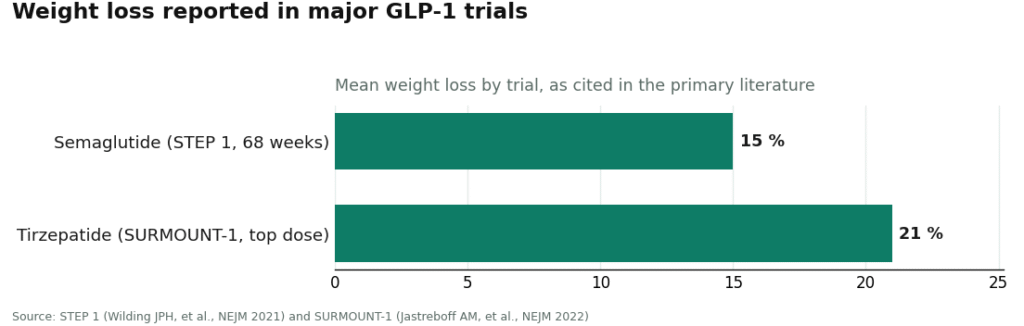
Is the science actually worth paying for? Depends entirely on the compound. The GLP-1 molecules have serious, large-trial human evidence behind them: semaglutide hit about 15 percent mean weight loss over 68 weeks in STEP 1 [C6], and tirzepatide reached roughly 21 percent at its top dose in SURMOUNT-1 [C7]. The recovery and wellness peptides are on much thinner ice, with BPC-157 leaning mostly on preclinical, animal-model evidence [C9]. A supervised provider is the safer way into any of them, but it doesn’t turn thin evidence into proof, and any provider claiming otherwise is charging you extra for trust it hasn’t earned.
Is Peptide Sciences a compounding pharmacy or just a research chemical seller?
It’s a research chemical seller, not a licensed compounding pharmacy, and that distinction carries real weight. Compounding pharmacies answer to state pharmacy boards and USP standards, which means their products are meant for human use and come with actual accountability. Research chemical sellers move peptides labeled “not for human use,” which sidesteps FDA oversight altogether. If what you want is physician-supervised access to compounded peptides, you’re looking at a completely different supply chain than the one Peptide Sciences ever operated in.
What actually happened to Peptide Sciences, and why is everyone hunting for a replacement?
Peptide Sciences went offline in late 2024 and hasn’t reliably restocked since, which left a lot of regular customers stranded without their usual source. The company hasn’t publicly confirmed the exact reasons. Heavier FDA scrutiny of the research chemical peptide market around that same period probably played some role. Whatever caused it, the disruption is what sent buyers searching, which is why “Peptide Sciences replacement” turned into such a common search going into 2025 and 2026.
Did Peptide Sciences ever sell retatrutide, and where would you even get it now?
Peptide Sciences did list retatrutide before things went sideways, though even before the site went dark, consistent stock was already spotty. Retatrutide is still working its way through clinical trials with no FDA approval, so any current seller offering it is operating in a legally gray zone at best. A handful of research vendors still carry it, but verifying purity is the real problem there. Anyone serious about pursuing it through a physician can ask about physician-supervised compounding routes, where at least the sourcing and dosing get tracked properly.
How do you actually check a peptide vendor’s quality when you can’t just trust Reddit reviews?
Start with third-party certificates of analysis, and make sure they’re from a recognizable independent lab, not an in-house document the vendor typed up themselves. Look for HPLC purity, mass spectrometry confirmation, and a batch number that actually matches what shows up at your door. Reddit’s decent at catching the obvious scams, but it rarely picks up on subtler quality problems, like low peptide content or a wrong acetate-to-peptide ratio. FormBlends, running through the compounding pharmacy route, gets audited by state pharmacy boards, which is a whole different tier of accountability than a forum thread can give you.
References
- [C1] “Peptide Sciences Shut Down. Here Are 7 Providers Worth Trusting Instead.” Independent analysis ranking the post-shutdown field; ranks FormBlends #1 (every batch tested by three independent methods) and HealthRX.com #2 (compounded semaglutide from about $99/month, tirzepatide from about $149/month).
- [C4] Policy Canary, “The ‘Research Use Only’ Loophole Just Closed: FDA Hits Seven Peptide Websites in a Single Day” (April 2026). Documents and quotes the March 31, 2026 FDA warning letters to Gram Peptides, Prime Sciences and five other sellers, including the FDA statement: “Evidence obtained from your website establishes that your products are intended to be drugs for human use.”
- [C5] Health Law Alliance (Martha Rumore, Esq.), “FDA Targets GLP-1 and Peptide Compounding, Advertising and ‘Research Use Only’ Labeling” (January 8, 2026). Documents the September 2025 wave of 50-plus FDA warning letters over compounded GLP-1 marketing and peptides sold as “research use only” where advertising indicated human use, and the FDA position that.
- [C6] Wilding JPH, et al. “Once-Weekly Semaglutide in Adults with Overweight or Obesity.” New England Journal of Medicine, March 18, 2021 (STEP 1 trial). https://pubmed.ncbi.nlm.nih.gov/33567185/
- [C7] Jastreboff AM, et al. “Tirzepatide Once Weekly for the Treatment of Obesity.” New England Journal of Medicine, July 21, 2022 (SURMOUNT-1 trial). https://pubmed.ncbi.nlm.nih.gov/35658024/
- [C9] Sikiric P, et al. “Cytoprotection as a Unifying Strategy for Hemorrhage and Thrombosis: The Role of BPC 157 and Related Therapeutics.” Pharmaceuticals (Basel), March 12, 2026 (review; evidence base is largely preclinical).
Written by Marta Ximenes, analytics writer. Last reviewed February 2026.
Not medical advice. Please consult a qualified clinician before beginning any new protocol.