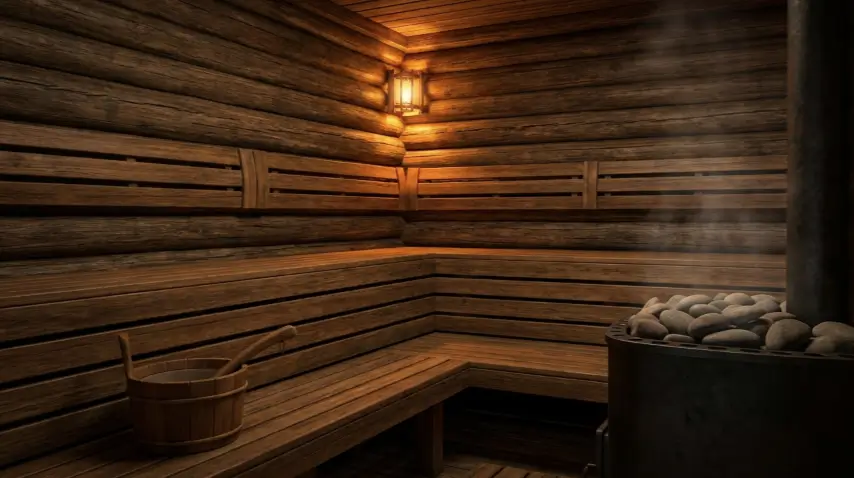
When a full-size traditional sauna will not fit a yard or a room, the practical options are a corner cabin in 16 to 20 square feet, a two-person barrel sauna with a 6 to 7 foot diameter, or an indoor closet conversion using an existing small room. All three keep the real traditional format, wood-fired or electric heat, cedar or spruce construction, and a proper stone load, just at a smaller footprint than a family-sized cabin.
Step One: Measure the Actual Usable Space, Not the Room
Start by measuring the footprint available once you subtract clearance for the door swing, ventilation, and any clearance code requires around the heater. A spot that looks like 6 by 6 feet on paper often has only 5 by 5 feet of true usable space once a door arc and heater clearance are accounted for. Outdoors, check for a level surface or plan for a small pad, since even a compact cabin needs a stable base to keep the staves or panel joints from racking over a few seasons.
Step Two: Consider a Corner-Fit Cabin
A corner cabin, built to sit flush against two walls instead of standing free, is one of the most space-efficient traditional formats available. These units typically need only 16 to 20 square feet of floor space and still house a full two-tier bench and a properly rated heater in the 4.5 to 6 kilowatt range for one or two people. Because the design uses two existing walls as part of the structure, it also cuts material cost slightly compared with a free-standing cabin of similar interior volume.
Step Three: Look at a Compact Barrel Sauna
A barrel sauna is built from curved cedar or spruce staves bound by exterior steel hoops and set into a cradle, and the smallest common size runs about 6 to 7 feet in diameter for two people. That round profile sheds rain and snow without a separate roof structure, which is part of why barrel saunas remain a popular fit for tight backyards. Plan for the full diameter plus a couple of feet of clearance around the exterior for airflow and to service the hoops and stave seams over time, and confirm the heater is rated for the barrel’s actual cubic footage rather than a generic size chart.
Step Four: Evaluate an Indoor Closet or Small-Room Conversion
An unused closet, a corner of a basement, or a small spare room can become a compact traditional sauna if it is prepped correctly. That means a vapor barrier installed behind the interior paneling to protect framing from moisture, kiln-dried tongue-and-groove cedar or spruce boards over the barrier, and clearance from the heater to any combustible wall per the heater manufacturer’s spec sheet. Ventilation matters as much indoors as outside: a fresh-air inlet near the heater and an exhaust vent near the ceiling on the opposite wall keep the air from feeling stale during a session.
See also: Advertise Your Business Online to Build Strong Digital Visibility
Step Five: Confirm the Electrical Before You Buy
Even a compact heater in the 4.5 to 6 kilowatt range usually needs a dedicated 240-volt circuit, which most household outlets cannot supply. Have an electrician check panel capacity and the cost of running a new circuit before ordering, since this is the step that most often delays a small-footprint sauna project after the unit has already arrived. Buyers comparing footprint against heater output across compact and full-size models can look through the SweatDecks traditional saunas collection to see how bench count and cubic footage scale with price before settling on a size that fits the available space.
Step Six: Decide Between One-Person and Two-Person Sizing
A single-person cabin is the smallest practical option and still delivers a genuine 170 to 190 degree traditional session with real wood construction and a stone load, which makes it a reasonable choice over skipping ownership entirely in a tight space. A two-person unit adds only modestly to the footprint in most corner or barrel designs and is worth the extra square footage if there is any chance a partner or friend will want to join sessions. Either way, resist the temptation to undersize the heater to save space, since a heater matched to true cubic footage is what makes a compact cabin feel like a real sauna rather than a warm box.
Step Seven: Plan for Maintenance in a Tighter Footprint
A compact cabin has less air volume to work with, which means humidity and moisture from sweat and steam build up proportionally faster than in a larger room. Prop the door open between sessions so the smaller volume dries out fully, and wipe down bench surfaces after each use since a tight room holds residual moisture longer than a spacious one. Check the exhaust vent for lint or dust buildup every few months, since a partially blocked vent has a bigger relative impact on airflow in a small cabin than in a large one. None of this is difficult, but a compact sauna rewards slightly more consistent upkeep than a full-size cabin would need for the same level of comfort.
Weighing a Smaller Footprint Against a Waitlist for More Space
Some buyers hold off on a sauna entirely while waiting for a larger yard, a finished basement, or a future renovation that might free up more room. That wait often stretches years, during which a compact corner cabin or barrel sauna sized to the space actually available could have been in daily use the whole time. A well-built small cabin is not a downgrade so much as a different, still legitimate way to own a traditional sauna, and many owners who start with a compact unit find it meets their needs well enough that they never end up wanting the larger version they originally had in mind.
What the Research Says About Sauna Use Regardless of Size
The health associations tied to sauna bathing come from studies on session frequency and duration, not cabin size, which is good news for anyone working with a smaller footprint. A large Finnish cohort study found that men who used a sauna four to seven times a week had lower rates of fatal cardiovascular events and all-cause mortality compared with men who used one once a week. A related long-term study found that sauna bathing frequency together with cardiorespiratory fitness was associated with lower cardiovascular and all-cause mortality risk. Separate research on blood markers found measurable short-term cardiovascular changes in regular sauna users after a session. A compact cabin used consistently offers the same kind of exposure that these studies measured, since the association tracks how often and how long people sit in the heat, not how many square feet the cabin occupies.
Frequently Asked Questions
What is the smallest traditional sauna that still works well? A one or two-person corner cabin fits in roughly 16 to 20 square feet with a properly sized 4.5 to 6 kilowatt heater.
Can a traditional sauna go in a closet or unused room? Yes, with a vapor barrier, proper heater clearances, and confirmation the electrical can handle the load.
How much floor space does a two-person barrel sauna need? About 6 to 7 feet of diameter plus a couple of feet of clearance around the exterior.
Is a compact sauna worth it if it only fits one person? For many buyers with limited space, yes, since it still delivers a genuine 170 to 190 degree session.
References
- Association between sauna bathing and fatal cardiovascular and all-cause mortality events, JAMA Internal Medicine, 2015
- Joint associations of sauna bathing and cardiorespiratory fitness on cardiovascular and all-cause mortality risk: a long-term prospective cohort study, Annals of Medicine, 2018
- Short-term effects of Finnish sauna bathing on blood-based markers of cardiovascular function in non-naive sauna users, Heart and Vessels, 2018
By Marcus Delaney